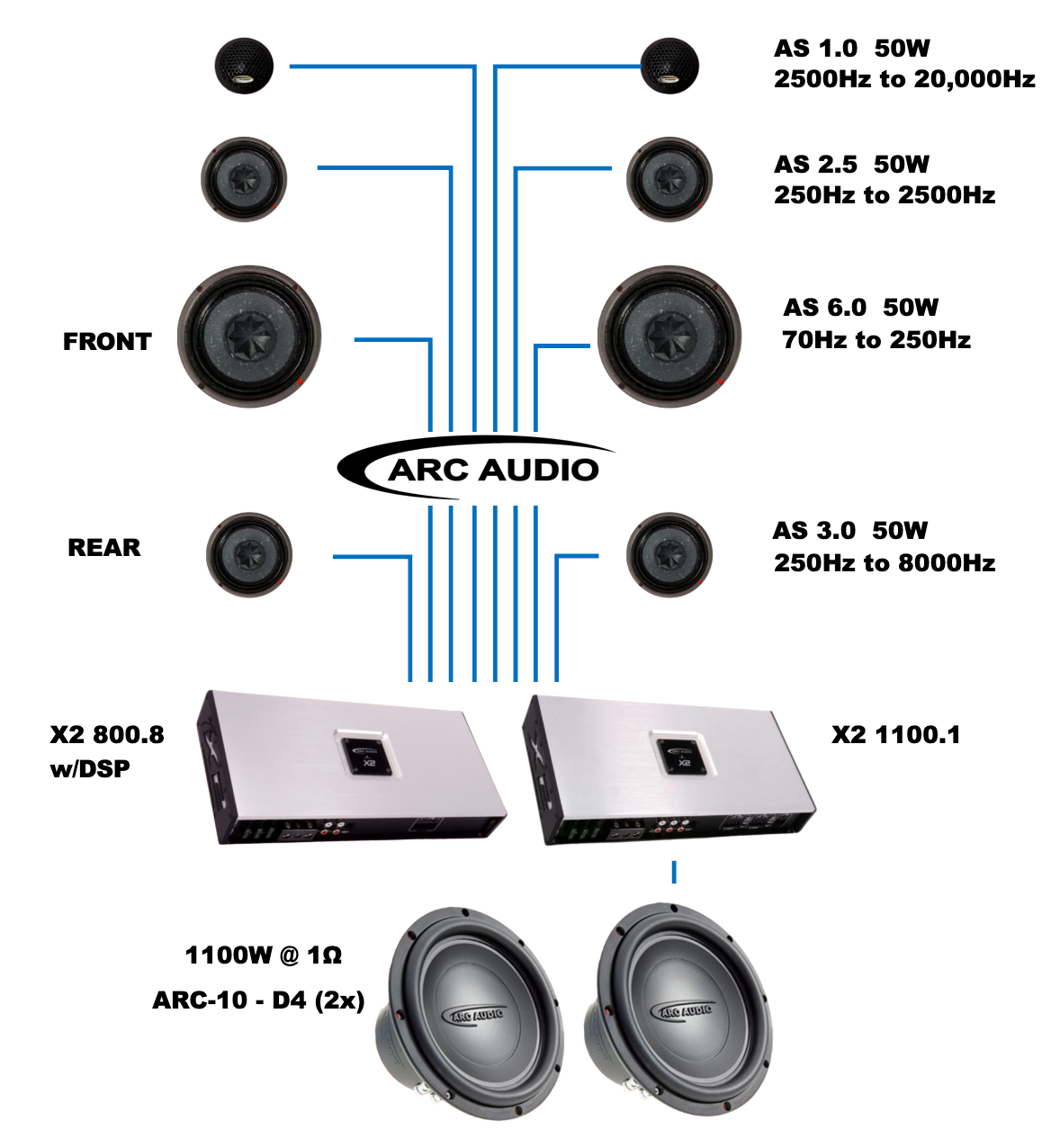
Why Your Car Needs an Arc Audio DSP: The Acoustic Reality of a Cabin
A car cabin is one of the harshest places on Earth to reproduce music accurately. Hard glass, tight dimensions, off-axis speakers, and a constant noise floor from the road all fight against the system you just spent thousands of dollars installing. Here is why a properly tuned Arc Audio DSP is not a luxury, it is the missing piece that makes everything else work.
The Cabin Is the Problem
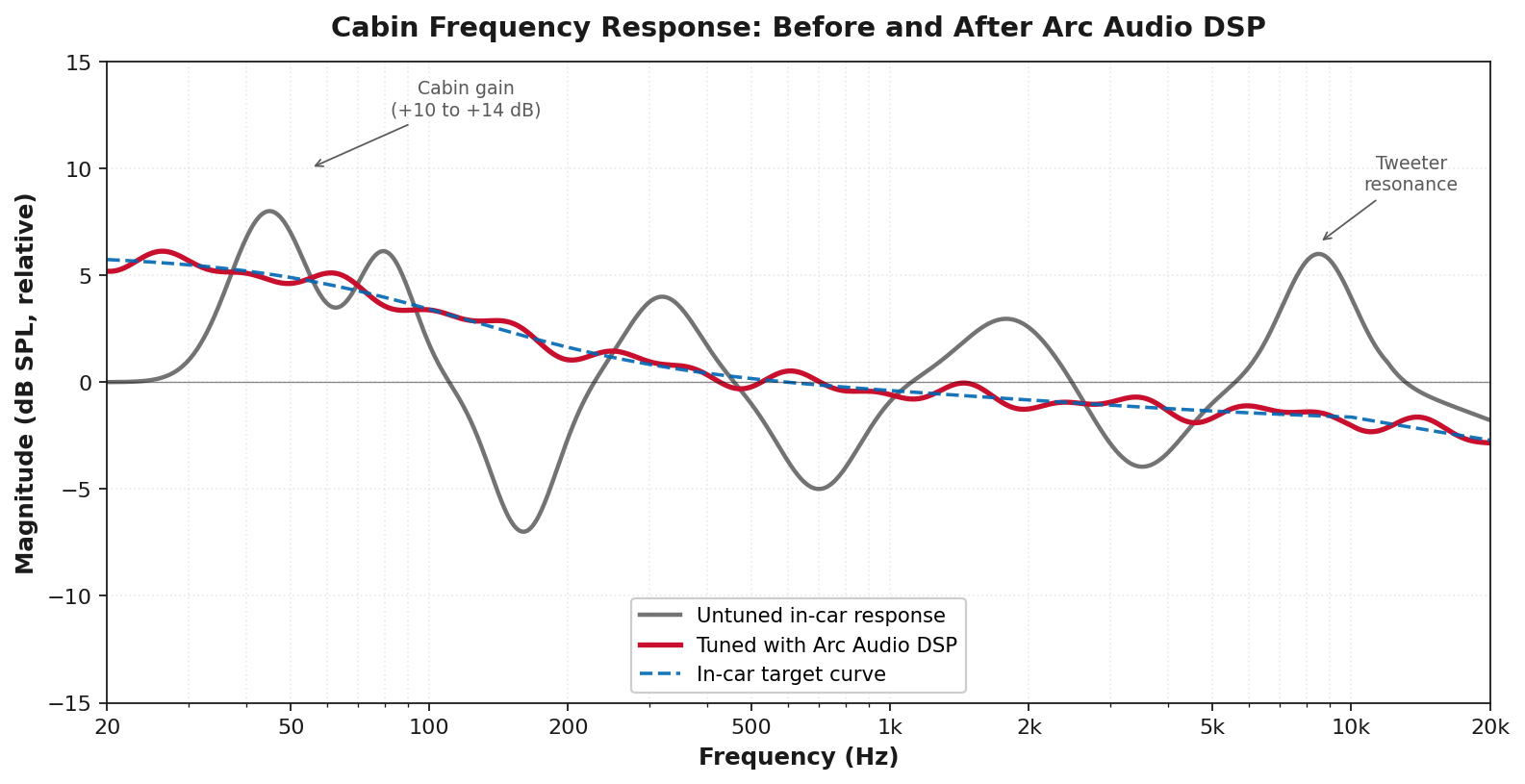
Take a great pair of speakers, a clean amplifier, and a quality source, then drop them into a vehicle. What comes out at the listening position rarely sounds like what went in. The car interior is small, sealed, full of reflective glass and absorptive seats, and it forces speakers into locations chosen by a body engineer rather than an acoustician. The result is a frequency response that bears little resemblance to flat.
Below about 200 Hz the cabin behaves like a pressure chamber. Wavelengths in that range are longer than the interior dimensions, so the cabin loads the woofers and adds 8 to 14 dB of boundary gain. Stack that gain on top of door panel resonances and seat absorption nulls, and the low end becomes a roller coaster. Above 200 Hz the room starts to act more like a small room with reflections and standing waves, producing peaks and dips every couple hundred Hz that no passive design can fix.
The Road Is Working Against You
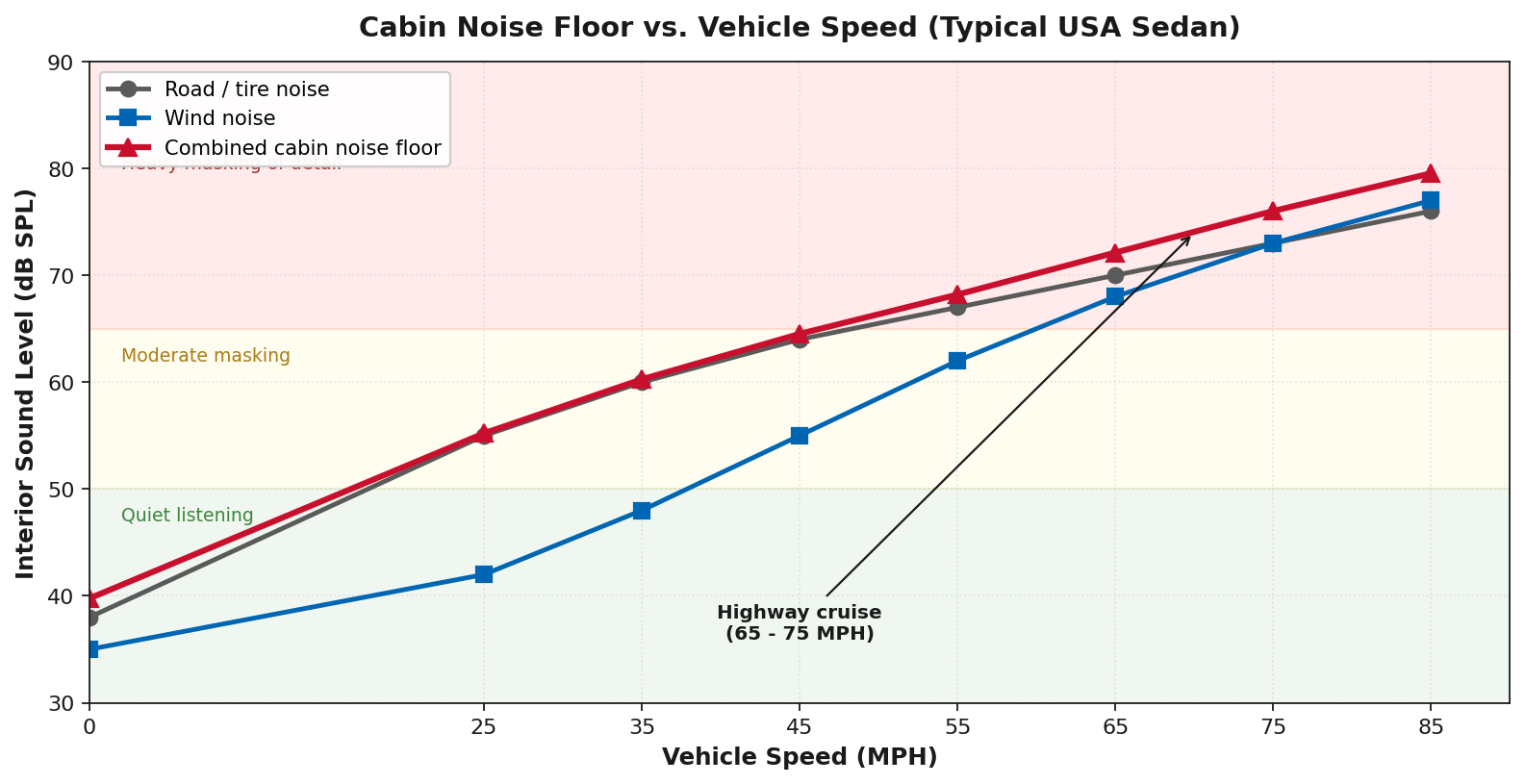
Music in a car never plays into silence. The moment the vehicle moves, tires generate broadband noise across the lower midrange, the wind starts loading the A-pillars, and the HVAC adds its own contribution. By the time you are sitting at a typical American highway cruise of 65 to 75 MPH, the cabin noise floor in most sedans sits between 68 and 73 dB SPL.
That noise floor masks musical detail in the worst possible way. Wind noise is concentrated in the 500 Hz to 4 kHz region, exactly where vocal intelligibility and instrument timbre live. Tire roar piles into the 60 to 300 Hz range and competes directly with the kick drum, bass guitar fundamentals, and the chest of a male vocalist. Without dynamic compensation, a mix that sounded balanced at a stoplight will sound thin and disconnected at freeway speeds.
USA Imaging Philosophy: Centered on the Dashboard
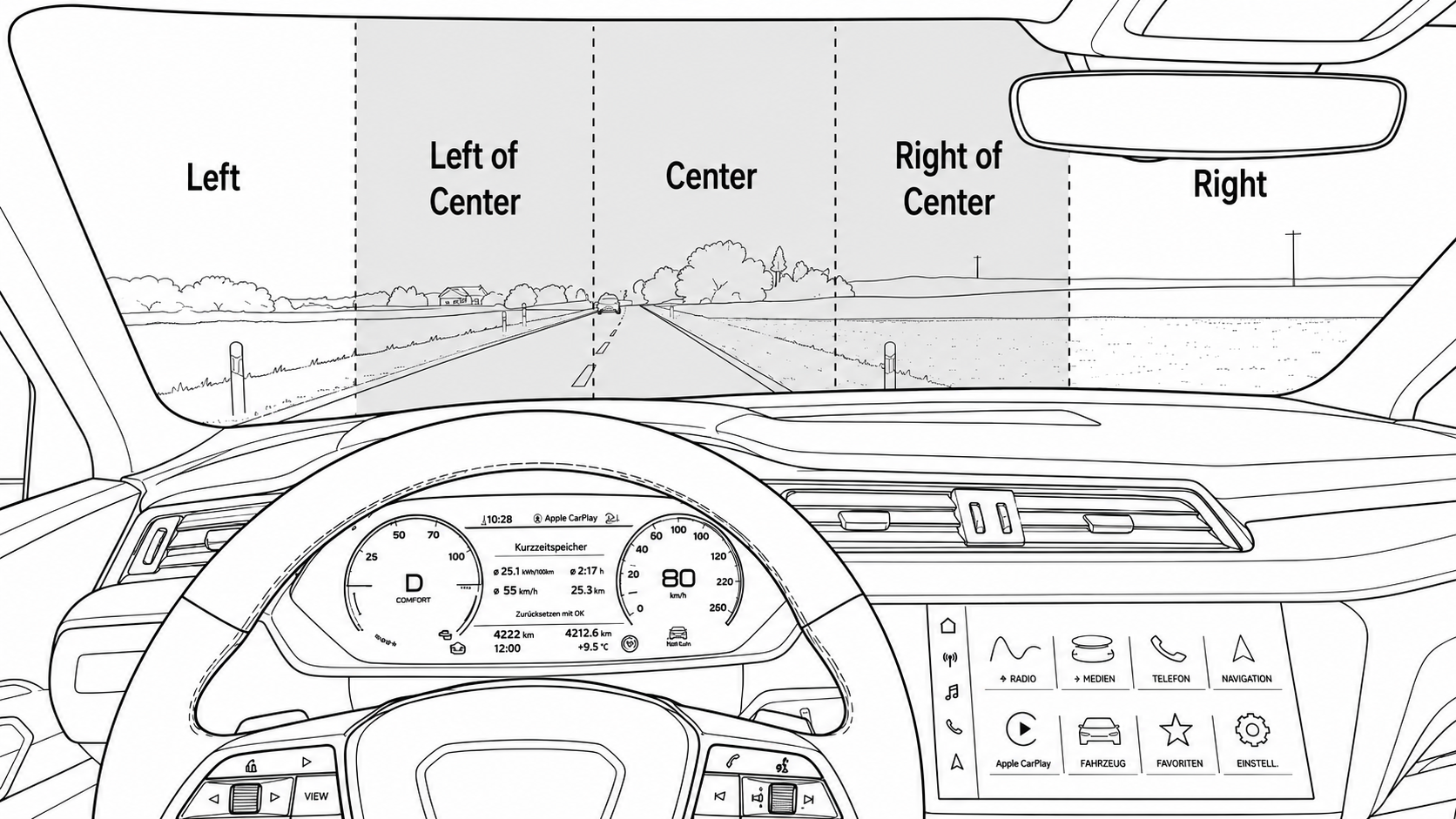
Speaker locations in a car are almost never symmetrical to the driver. The left tweeter is two feet from your ear, the right is four feet away, and the woofer is somewhere in a door panel below your knee. Without time correction, the closer speaker arrives first and pulls the entire stereo image to that side. Music collapses into the door instead of stretching across the dash.
The USA approach to staging, common across most domestic and Asian vehicle platforms, aims to lock the phantom center on the middle of the dashboard, equidistant between the driver and the front passenger. The goal is a stage that sits up high, spans the full width of the windshield, and gives both occupants a believable presentation. This is achieved entirely in the DSP through precise delay on the near-side channels and matched level trims on each pair, so the first wavefront from every driver arrives at the listening position at the same instant.
Speaker Placement and Tweeter Resonance Above 5 kHz
The high frequencies present a different set of headaches. Tweeters mounted in factory sail panels or A-pillars are almost always firing off-axis to one listener and on-axis to the other, which means the two sides have completely different response curves above 5 kHz. Hard-dome tweeters and wideband drivers also tend to break up in their top octave, producing resonance peaks that read as harsh, sibilant, or fatiguing.
Every manufacturer voices their tweeters a little differently, so the "trademark" sound of a brand often lives in this region. When you measure these speakers in a cabin you will see ripples, dips, and a characteristic peak somewhere between 7 and 12 kHz. Parametric EQ in the Arc Audio platform lets you surgically notch those resonances rather than tilting the entire top end down and dulling the music in the process.
What the DSP Actually Does
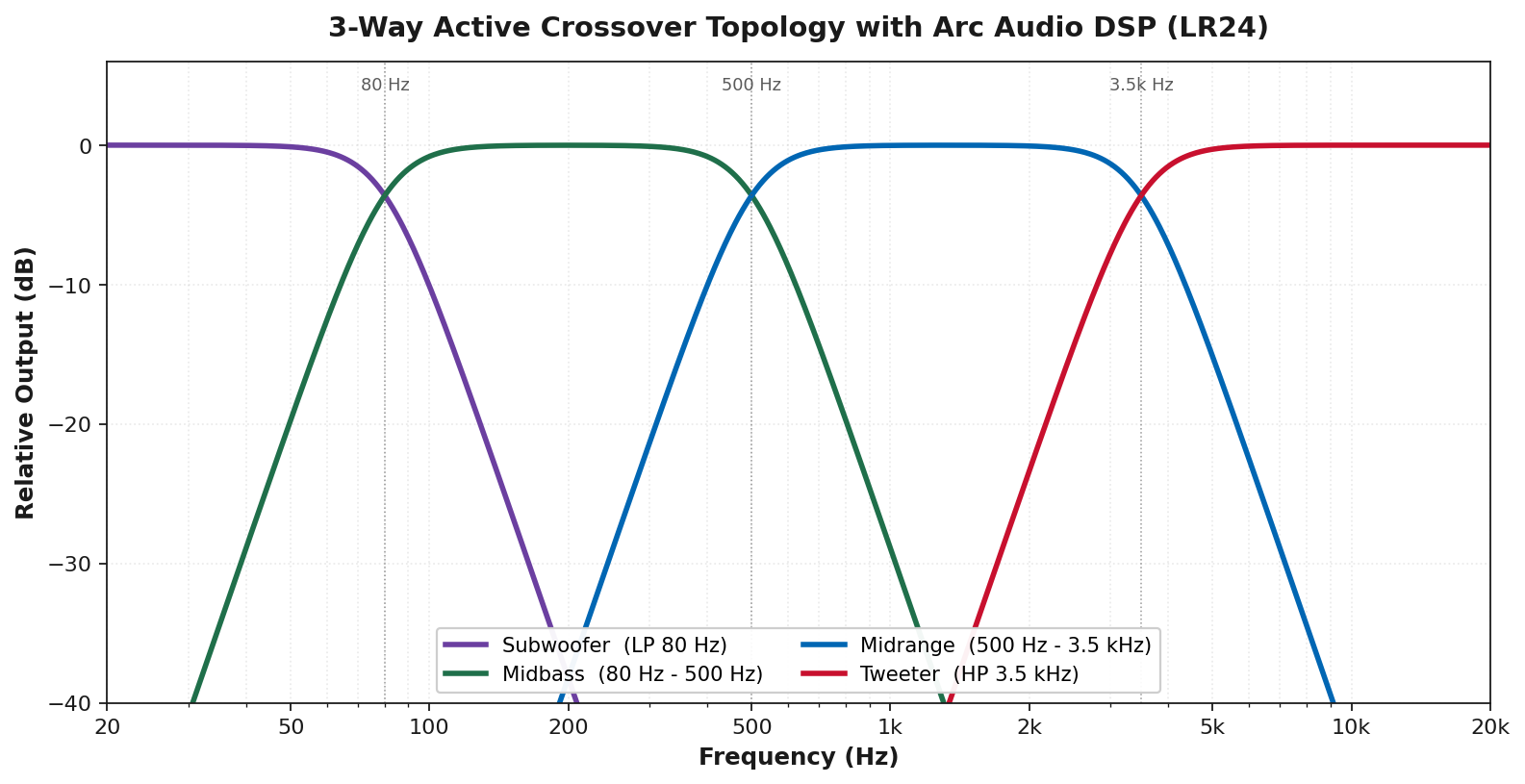
An Arc Audio DSP, whether the PSM-Pro, the Blackbird, or the IPS series, is not a magic equalizer. It is a complete signal management platform that handles four jobs:
- Active crossovers with selectable slopes up to 48 dB per octave, so each driver only sees the band it is designed to reproduce.
- Per-channel time alignment in sub-millisecond steps to compensate for unequal path lengths from each speaker to the listening position.
- Parametric and graphic EQ for surgically correcting cabin response, taming resonances, and matching the in-car target curve.
- Level matching and signal routing across every input and output, including factory integration with sum-and-restore for OEM source units.
Why "Less Is Sometimes More"
A common mistake when tuning is to reach for the EQ first and try to flatten every wiggle in the measurement. That approach almost always produces a system that measures well and sounds wrong. The cabin gain in the low end is partly responsible for the natural warmth a car system can deliver. The slight high-frequency rolloff at the listener is consistent with how our ears expect a real acoustic space to behave.
Good tuning means correcting the obvious problems first: time alignment, crossover integration, gross response errors and resonant peaks. Then a final pass of broad shaping toward an in-car target curve. The Arc Audio platform gives you the resolution and the tools to do all of that without having to fight the DSP itself.
Key Takeaways
- The car cabin imposes 8 to 14 dB of boundary gain in the low end and creates peaks and dips throughout the midrange that no passive system can fix.
- At highway speeds of 65 to 75 MPH, the interior noise floor in a typical USA sedan reaches 68 to 73 dB SPL and masks musical detail in the vocal range.
- USA-style imaging targets a centered phantom stage on the dashboard, which requires per-channel time alignment from the DSP.
- Tweeter resonances above 5 kHz are speaker and placement dependent and benefit from surgical parametric EQ rather than broad tilt.
- Arc Audio DSP platforms combine crossovers, time alignment, parametric EQ, and signal routing into a single tool that unlocks the potential of the rest of your system.